Implants
Plan Your Trip
Breast Implant Illness
FAQ
Journal
Polytech implants — reBreast™
Implant Technology

The right implant
for your anatomy.

Dr. Baley is not exclusive to any brand or technology. Every patient's case determines the right implant — not the other way around. A transparent look at the full spectrum available.

The approach

Not married to any brand.
Committed to the right answer for you.

The full Polytech catalog is available at this practice. So is Motiva, Mentor, and Eurosilicon. The implant choice is a clinical decision made case by case — based on your anatomy, your goals, your tissue characteristics, and the latest available safety data. No brand agreement, no inventory pressure, no agenda.

What follows is an honest overview of the technologies Dr. Baley uses most — their certifications, the clinical evidence, and why each has a place in specific cases.

On rePlantation®: The protocol uses Polytech polyurethane-coated (Microthane) implants, or B-Lite gel depending on patient profile. The choice between them is decided during your consultation — never predetermined.
PU · Lightweight · Germany
Polytech
CE-certified (EU MDR), ISO 13485. Microthane® PU surface and B-Lite® lightweight gel. Available in 60+ countries.
FDA Approved 2024 · Costa Rica
Motiva
First new FDA PMA approval since 2013. 0 BIA-ALCL in 3M+ implants. CE mark since 2011. 85+ countries.
FDA Approved · USA
Mentor
Johnson & Johnson. FDA-approved MemoryGel® and MemoryShape®. One of the most widely used globally.
CE Mark · France
Eurosilicon
French manufacturer. CE-certified. Competitive smooth and micro-textured options for the right anatomical cases.
Polytech Health & Aesthetics · Germany · Est. 1986

Microthane®
Polyurethane surface technology.

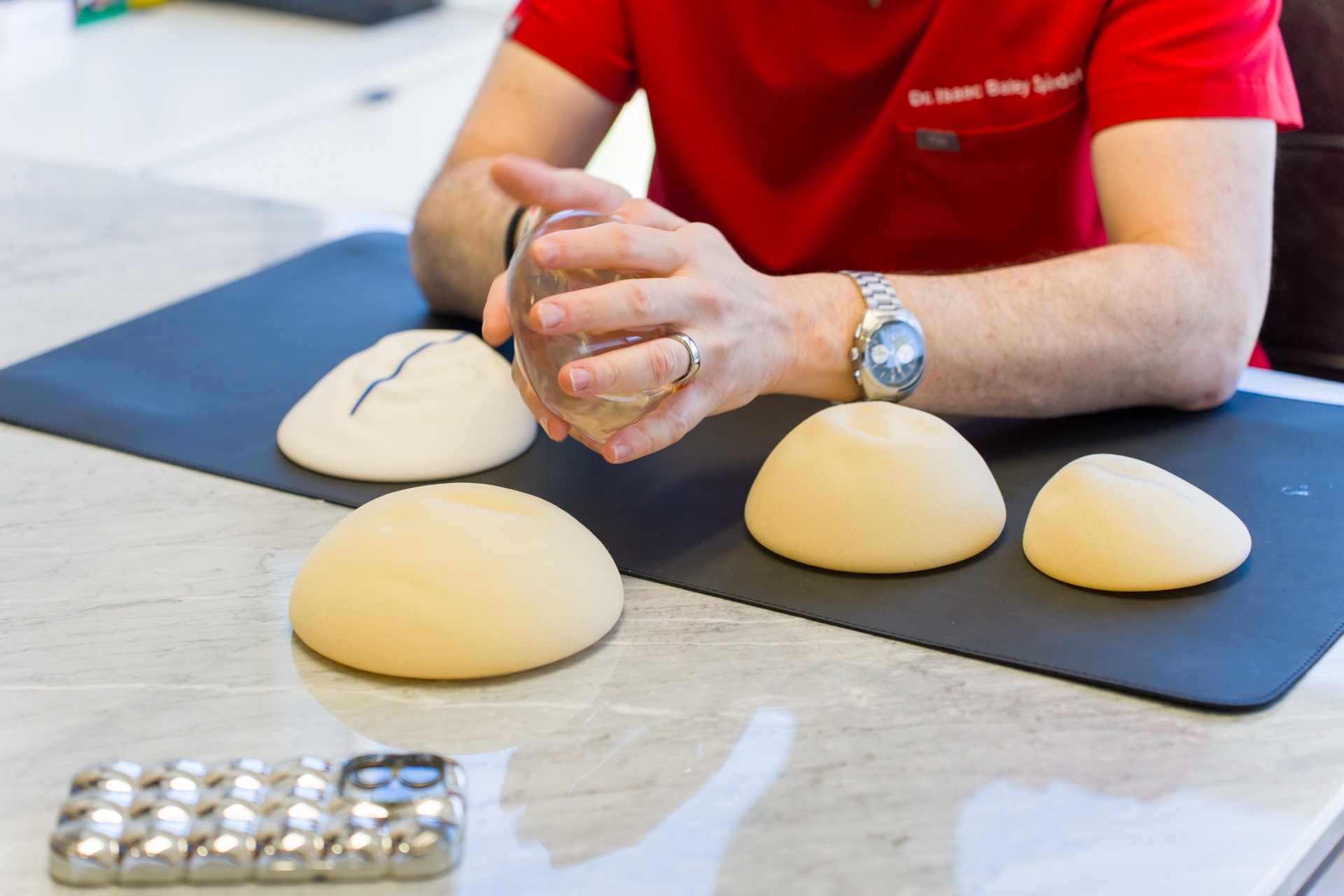
A three-dimensional polyurethane foam surface that allows tissue to grow into the implant matrix — anchoring it, reducing rotation, and lowering capsular contracture rates. CE-certified under EU MDR. Used in rePlantation® for specific clinical indications.

Polytech's Microthane® implants are coated with a three-dimensional open-pore polyurethane foam matrix. Unlike standard smooth or macro-textured surfaces, this coating allows tissue to grow directly into the implant — anchoring it in place, virtually eliminating rotation, and dramatically reducing capsular contracture rates.

Polytech has operated a patient registry since 2007 — one of the longest-running post-market surveillance programs in the industry. The Mesmo 5-year study, published 2022, followed 919 patients: zero cases of BIA-ALCL.

On France and Australia

In 2019, France banned all macro-textured and polyurethane implants. The scientific community's response was divided. The European Association of Aesthetic Plastic Surgeons (EUSOMA/ESSO) published a position paper questioning whether the ban was clinically justified or over-cautious — noting that polyurethane implants have a distinct biological mechanism from macro-textured surfaces and should not be grouped together.

The Netherlands' RIVM — asked by its own government to assess the scientific basis of France's decision — concluded that the evidence did not justify a ban beyond Allergan's Biocell product specifically. Polytech publicly contested the ANSM ruling as not based on scientific proof. The US FDA, the UK MHRA, and most European regulators did not follow France's lead.

Australia's TGA suspended some Polytech products as part of a broader precautionary review. This position has since been revisited in the global literature. Most of Europe, Latin America, and Asia continue to offer Polytech PU under CE certification.

Why not FDA-approved? Polytech has not submitted a Premarket Approval (PMA) application to the FDA for the US market — not because of safety concerns, but because the commercial pathway has not been pursued. Polytech is in early discussions with the FDA regarding US market entry for specific products including B-Lite. This is precisely why patients travel to access this technology outside the US.

Certifications

  • CE mark (EU MDR 2017/745) — confirmed 2023, covering Germany, Spain, Belgium, Netherlands, and most of Europe
  • ISO 13485:2016 — quality management system certification
  • Available in 60+ countries across Latin America, Asia, Middle East, and Europe
  • First European breast implant manufacturer to receive CE mark (1995)
  • Not available in France (country-specific 2019 ban, still in effect)
  • Not FDA-approved for US market — FDA approval process not yet initiated
0
BIA-ALCL cases in Polytech Mesmo 5-year study (919 patients, published 2022)
<1%
Capsular contracture rate at 5 years — vs. 10–15% for smooth surface implants
1986
Founded. Family-owned. Dieburg, Germany.
60+
Countries where Polytech products are available

How the PU surface works

The polyurethane foam creates a microenvironment at the implant-tissue interface. Tissue grows into the open-pore matrix, effectively anchoring the implant in a way that smooth and even textured shells cannot replicate. This is why rotation rates are nearly zero, and why capsular contracture — the most common long-term complication of breast implant surgery — is markedly reduced.

The surface is biocompatible and has been used in cardiovascular and other medical applications for decades before its use in breast implants.

Polytech B-Lite® · Lightweight Gel Technology

30% lighter.
Same size. Better long-term mechanics.

B-Lite is a genuinely novel material — the first meaningful innovation in breast implant composition in a generation. Hollow microspheres developed for the aerospace industry, permanently bonded within cohesive silicone gel.

Standard silicone implants exert gravitational force on breast tissue — every day, for years. This cumulative mechanical stress contributes to ptosis (sagging), tissue thinning, and long-term shape change. B-Lite directly addresses this by reducing the weight of the implant by approximately 30% while maintaining equivalent volume, profile, and feel.

The hollow microspheres used in B-Lite gel are made from borosilicate glass — the same material used in medical and aerospace applications. They are permanently encapsulated within the silicone matrix and biocompatible by independent testing.

5-year clinical evidence

A 5-year post-market study found 94.9% of patients rated aesthetic outcome as satisfied or very satisfied. 95.5% rated natural look and feel as satisfied or very satisfied. No new or unexpected safety signals. The study confirmed that reduced mechanical load on tissue translates to measurable improvements in long-term breast shape stability.

Who B-Lite is best for: Patients with naturally thin or stretched tissue who want to minimize long-term gravitational effects. Patients returning for secondary surgery after previous large implants. Active patients concerned about dynamic force during exercise. Cases where volume is desired but tissue support is limited.
30%
Lighter than standard silicone implants of equivalent volume
94.9%
Patient satisfaction with aesthetic outcome at 5 years
100%
MRI compatible. No interference with standard imaging.
CE
CE-certified. Same Polytech quality standards. Available in all markets where Polytech is sold.
  • Aerospace-grade microspheres — borosilicate glass, permanently bonded in gel
  • Available in round and anatomical — full Polytech shape catalog
  • Compatible with Microthane surface — B-Lite Microthane version available
  • Same incisions, same technique — no procedural changes from standard implants
Other options available

Also available
at this practice.

For patients who specifically want an FDA-approved implant, or whose anatomy calls for a different approach, the following options are all available. The full consultation determines which is right.

01
Motiva
Establishment Labs · Costa Rica · FDA Approved 2024

The first new breast implant to receive FDA Premarket Approval since 2013 — approved in 2024, making Motiva the most recently FDA-approved breast implant in the US market. Zero cases of BIA-ALCL in over 3 million implants distributed globally since 2010. Available in 85+ countries. CE-marked since 2011. SmoothSilk® surface and Ergonomix® ergonomic shape range — implants that respond to body position the way natural tissue does.

FDA PMA CE Mark ISO 13485 85+ Countries
02
Mentor
Johnson & Johnson · USA · FDA Approved

One of the two longest-established FDA-approved implant brands in the United States. MemoryGel® cohesive silicone gel and MemoryShape® anatomical range. Decades of post-market safety data. A conservative, well-documented choice for patients who prioritize the FDA track record above all else. Smooth and moderately textured surface options available.

FDA PMA CE Mark ISO 13485 Global Markets
03
Eurosilicon
Eurosilicon · France · CE Certified

A CE-certified European manufacturer offering smooth and micro-textured silicone gel implants. A strong option for patients who want a well-tested implant without the premium of larger brands. Round and anatomical profiles available. Solid clinical track record across European and Latin American markets. Available in all relevant anatomical sizes and projections.

CE Mark ISO 13485 Europe · LatAm
The honest truth about FDA approval: FDA approval means a product has met the FDA's clinical evidence standards for the US market. It does not mean the product is superior to non-FDA-approved options — Motiva was available in 85 countries for over a decade before US approval, with outstanding safety data throughout. The FDA approval process is rigorous but it is also a market access process, not a universal quality ranking. The right implant is the one that fits your anatomy and your goals, regardless of which regulatory body approved it first.
Choose with full information

The right implant
starts with the right conversation.

Dr. Baley reviews your anatomy, your history, and your goals — then recommends the implant that fits. No sales agenda. No predetermined answer. Just the right clinical choice for you.

JCI
Centro Médico ABC
CMCPER
AMCPER
ISAPS
ASPS